

Sustainable Lies That Bind
Reflections on the Historic G20 Summit in South Africa

In our age, two rival forces stand locked in mortal combat for the soul of the modern civilizations: nationalism and globalism.
Nationalism insists on the sovereignty of the nation-state and the right of a people to govern themselves without foreign interference. Globalism, by contrast, seeks the consolidation of power into the hands of transnational elites who dream of a borderless world. It seeks to construct a global state, collapsing distinctions, dissolving sovereignty, and managing the future through a centrally planned economy.
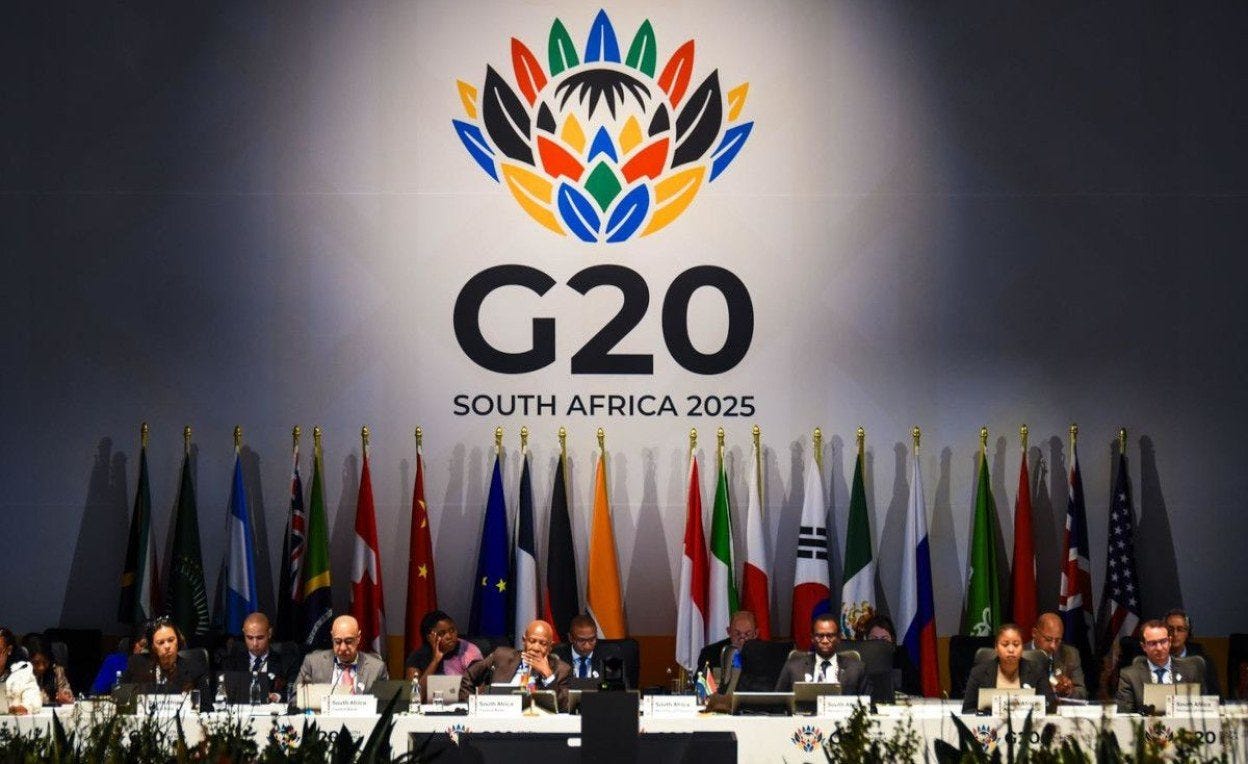
On November 22-23, 2025, South Africa had the rare privilege of hosting one of the most influential global gatherings in modern geopolitics, held for the very first time on African soil at the historic G20 Summit. For two days, the halls swelled with delegates and heads of state from across the world, each representing a nation woven into the Group of Twenty circuit.
The theme of this summit was solidarity, equality, and sustainability. Solidarity was framed as a global moral imperative; equality was the rallying cry for a technocratic restructuring of society; sustainability was the North Star of a new future order. The summit was rooted in the belief that solidarity, equality, and sustainability are the key pillars for inclusive growth (whatever that means).
After the ceremonial welcomes, South African President Cyril Ramaphosa’s opening monologue set the tone and laid the ideological groundwork for the entire event.In that monologue, President Ramaphosa stated the G20’s commitment to cosmic justice, the modern doctrine of social justice, which assumes that disparities are themselves the smoking gun of vast, multifaceted systems of discrimination.
President Ramaphosa’s speech was not merely a collection of diplomatic pleasantries. It was a confession of faith, a doctrinal recitation of the creed that undergirds much of the global discourse surrounding sustainable development. His monologue was nothing less than an affirmation of faith in this globalist project, a vision that masquerades as progress while quietly impoverishing the African continent.
The 2025 G20 Summit culminated in the landmark Leaders’ Declaration, which formalized yet again a fundamental commitment to globalism, draped in the language of compassion, equity, and sustainability.
Diplomatic platitudes have long become the liturgy of globalist elitism. This seductive language presents sustainable development as the golden pathway to human flourishing. Yet what lurks beneath the surface is something far more sinister. This kind of rhetorical flourish conceals a deeper intent: sustainable development is less about development and far more about control. It is about maintaining control over fragile and poverty-stricken African economies through well-calculated policies.
Nowhere is this more evident than on the African continent. Sustainable development is a Trojan horse for power. It is a well-oiled machinery by which Africa remains a state of perpetual dependency in a global household dominated by technocrats. Its promises of partnership are often schemes of quiet domination. This unchecked vision of progress is enshrined in the principles of the Sustainable Development Revolution. Consumption is where production goes to die.
In this sense, the so-called sustainable future is built on sustainable lies that bind, lies that present themselves as benign and philanthropic endeavors while keeping Africa in the dark. It scripts policies that discourage national sovereignty, native agency, and upward economic mobility. It incentivizes corruption and wraps with the bureaucratic red-tape. These sustainable lies keep Africa in a state of economic perpetual adolescence, all in the name of sustainable development
Africa needs the liberating truth that shatters the elusive promises of globalism. The freedom to chart its own course, to cultivate its own future, and to break free from the ever-tightening chains of a system not designed for human flourishing but global totalitarianism.